
TCM + Science
How Red Light Therapy Works — And Why It Aligns with Traditional Chinese Medicine
You've probably heard of red light therapy. But you may not know that the principles behind it — stimulating cellular energy, improving circulation, reducing inflammation, and supporting the body's natural repair systems — have been central to Traditional Chinese Medicine for over 2,000 years.
At Qi Wellness Co, we don't see these as competing systems. We see them as the same truth, arrived at from different directions.
What Is Red Light Therapy?
Red light therapy (also called photobiomodulation, or PBM) is the application of specific wavelengths of red and near-infrared light to the body. Unlike UV light, which damages skin, red and near-infrared light penetrates the skin and is absorbed by cells — where it triggers measurable biological responses.
The primary mechanism is well established: light energy is absorbed by cytochrome c oxidase, a photoreceptor enzyme inside the mitochondria (your cells' energy factories). This absorption stimulates the production of ATP — adenosine triphosphate, the molecule that powers every cellular process in your body.
When cells have more energy available, they do what they're designed to do: repair, regenerate, and function optimally.
What the Research Shows
Red light therapy is one of the most studied non-invasive wellness technologies in existence. The research is published across thousands of peer-reviewed studies in journals covering dermatology, sports medicine, neurology, and oncology. Some of the most consistent findings include:
Skin Health
-
Significant increases in collagen and elastin production after consistent use (Barolet et al., Journal of Investigative Dermatology)
-
Reduction in fine lines, wrinkle depth, and skin roughness
-
Improvement in acne, rosacea, and psoriasis symptoms
Pain & Inflammation
-
Reduction in markers of systemic inflammation (TNF-α, IL-6, IL-1β)
-
Clinically significant improvement in osteoarthritis and rheumatoid arthritis joint pain
-
Accelerated healing of musculoskeletal injuries
Recovery & Performance
-
Reduced post-exercise muscle soreness and faster strength recovery
-
Improved endurance and reduced fatigue in athletes
-
Documented use by professional sports teams worldwide
Hair Regrowth
-
Increased follicle activity and hair density in androgenic alopecia
-
Evidence of benefit in both male and female pattern hair loss (Laser Surg Med, 2014)
Sleep & Mood
-
Regulation of circadian rhythm through melatonin pathway influence
-
Improved sleep quality in chronic insomnia studies
-
Mood support via serotonin and cortisol modulation
Note: Red light therapy devices are wellness tools, not medical treatments. They are not intended to diagnose, treat, cure, or prevent any disease. Consult your healthcare provider for medical concerns.
The TCM Connection
Traditional Chinese Medicine operates on a fundamentally different vocabulary than Western biomedicine — but the underlying observations about the body are remarkably consistent.
Qi and ATP In TCM, Qi (氣) is the vital energy that flows through the body's meridian pathways, powering every physiological function. When Qi flows freely, the body is healthy. When Qi is stagnant or deficient, illness and dysfunction follow.
Modern biology identifies ATP as the molecular currency of cellular energy — the compound that fuels every enzymatic reaction, muscle contraction, and repair process in the body. Red light therapy directly increases ATP production.
Different language. The same truth.
Blood Circulation and Wei Qi TCM places enormous emphasis on the circulation of Blood (Xue) and the body's defensive energy (Wei Qi). Impaired circulation underlies most patterns of pain, stagnation, and degeneration in TCM diagnosis.
Red light therapy consistently improves local and systemic microcirculation — increasing blood flow, improving oxygen delivery to tissues, and accelerating the removal of metabolic waste products.
Inflammation as "Heat Toxin" In TCM, inflammatory conditions are often classified as patterns of Heat or Damp-Heat — excess energetic states that damage tissue and obstruct flow. The anti-inflammatory effects of red light therapy — measurably reducing inflammatory cytokines — mirror TCM's therapeutic aim of clearing Heat and restoring balance.
The Meridian System and Acupuncture Points Research in photobiomodulation has found that light applied directly to acupuncture points produces physiological effects consistent with needling — influencing connective tissue, local circulation, and nerve conduction. Our wellness patches are positioned at traditional acupuncture point locations for this reason.
The Wavelengths, Explained
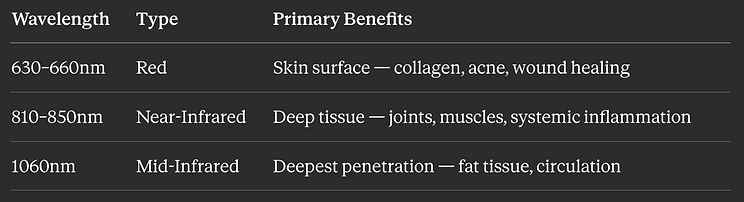
Not all light is the same. The therapeutic benefits of red light therapy depend on using the correct wavelengths at sufficient intensity (irradiance).
Why wavelength matters: Each wavelength penetrates to a different depth and is absorbed by different cellular components. Red light (630–660nm) works primarily at the skin level. Near-infrared (810–850nm) penetrates 2–3cm into tissue, reaching muscle, joint, and even bone. Using both simultaneously — as our panels do — provides layered, comprehensive therapeutic benefit.
How to Use Red Light Therapy
Recommended protocols:
Tips:
-
Consistency matters more than session length. Daily 15-minute sessions outperform occasional 30-minute sessions.
-
Red light therapy works best on bare skin — clothing blocks the wavelengths.
-
Sessions at the same time each day (especially morning or early evening) reinforce circadian benefits.
-
Red light therapy is complementary to — and works synergistically with — topical skincare, including our Qi Nourish Tallow Cream.

Is It Safe?
Red light therapy has an excellent safety profile and is non-ionizing (does not damage DNA like UV or X-rays). It has been used in clinical settings for decades.
Safe for:
-
All skin types and tones
-
Adults of all ages
-
Pets (with appropriate devices)
-
Daily use at recommended intensities
Consult your doctor before use if you:
-
Are pregnant
-
Have a history of photosensitivity or are taking photosensitizing medications
-
Have an active cancer diagnosis
-
Are using the device near the eyes without appropriate protection